
Things Fall Apart #3: Owner of the future
Footnotes & Tangents for chapters 10–13 of Things Fall Apart by Chinua Achebe

At last they took a turning and began to head for the caves. From then on, Chielo never ceased in her chanting. She greeted her god in a multiude of names – the owner of the future, the messenger of earth, the god who cut a man down when his life was sweetest to him. Ekwefi was also awakened and her benumbed fears revived.
last week | main page | reading schedule | further resources
Hello and welcome to Week 3 of our slow read of Things Fall Apart by Chinua Achebe.
The third week covers chapters 10-13: an audience with the ancestors, a night of terrors, a marriage, a death and a banishment. I recommend reading this section of the book first, and then returning to this post to join in the discussion.

1. Audience with the ancestors
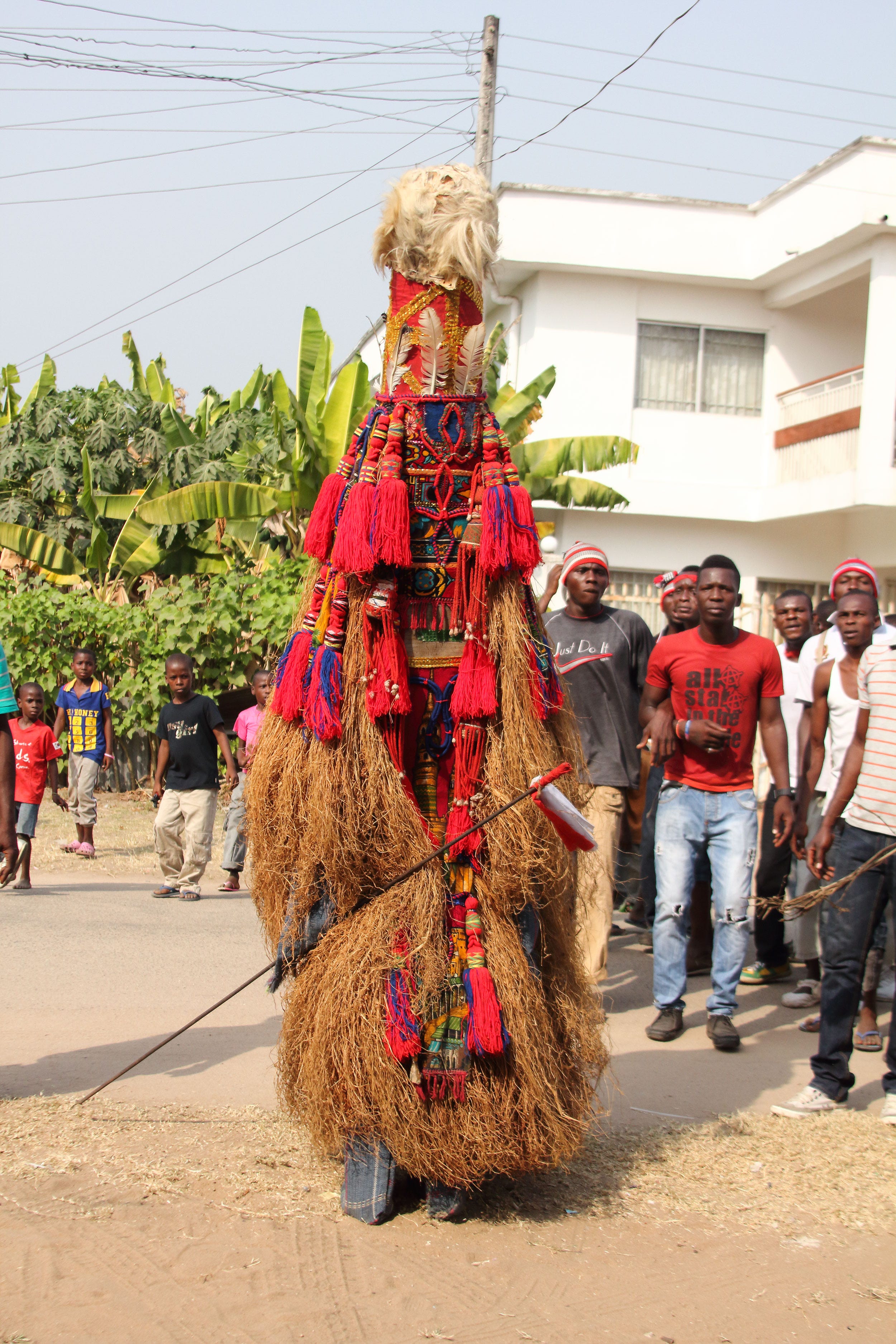
The drum sounded again and the flute blew. The egwugwu house was now a pandemonium of quavering voices: Aru oyim de de de de dei! filled the air as the spirits of the ancestors, just emerged from the earth, greeted themselves in their esoteric language.
Where does the power of the egwugwu come from? Who wields it and over whom?
The final four chapters of Part One present something like the “ideal” in pre-colonial Igbo society. We see how disputes are resolved through the intervention of ancestral spirits. We attend a successful uri, or betrothal ceremony, where everyone plays their part. And the death of Ezeudu, the eldest man in the village, shows Okonkwo and us what a perfect life and death may look like in Igboland.
Footnote: The Role of Spirits and Ancestral Spirits in Igbo Mythology (Oriire)
As we saw with the ogbanje and the Oracle last week, there is much to-and-fro between the human and spirit worlds. Those men who lived good lives and died well have joined the ranks of powerful ancestors who return to pass judgment on the living. And they are terrifying. But look closely, and we may recognise one of the egwugwu:
Okonkwo’s wives, and perhaps other women as well, might have noticed that the second egwugwu had the springy walk of Okonkwo […] But if they thought these things they kept them within themselves. The egwugwu with the springy walk was one of the dead fathers of the clan.
Notice their double consciousness: the egwugwu both is and isn’t Okonkwo. Achebe stands both within and outside the realm of religious experience, refusing to choose between a scientific and a mythic viewpoint. Both are true within the story of Things Fall Apart.
Can you think of examples of double consciousness in your own life?
.JPG)
2. All of you
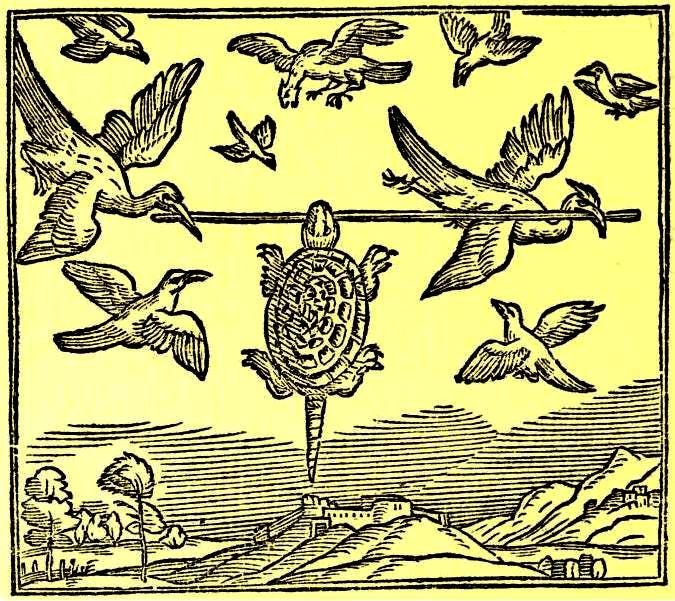
‘Tortoise turned to the birds and said: “You remember that my name is All of you. The custom here is to serve the spokesman first and the others later. They will serve you when I have eaten.”
What does the fable of the Tortoise and the Birds tell us about the significance of a shared culture and language in Umuofia?
It’s interesting to note that variations of this folktale exist worldwide, including versions in India and Ancient Greece. The moral of the story varies. In India, the talkative tortoise falls to its destruction when it can’t keep its mouth shut around a pole suspended by two geese. In Aesop’s Fables, a tortoise hitches a lift with an eagle to see the world, but is dropped to its death on a mountaintop.
In West African folklore and mythology, the tortoise appears as a trickster: “Nothing that happened in the world of the animals escaped his notice; he was full of cunning.”
How do you interpret this folktale?
It seems to speak to the dangers of underhanded actions, where individuals might speak on behalf of a community for their own interests or act out of greed.
It may be useful to revisit this fable as the story unfolds to consider how it relates to Okonkwo’s life and Umuofia’s encounter with British colonialism.


3. The night walk
How a woman could carry a child of that size so easily and for so long was a miracle. But Ekewfi was not thinking about that. Chielo was not a woman that night.
What is Chielo’s role in Umuofia and in this story? What does this section reveal about Ukonkwo’s character?
Chielo and Achebe wrongfoot us at every turn here. We have been primed for tragedy: the murder of Ikemefuna and the sickness of Ezinma make us expect the worst when Chielo takes her off into the forest.
Curiously, we end up in the same place as Ekwefi and Okonkwo: fearing what may happen to Ezinma and feeling powerless to stop it. I suspect that putting us in their place and identifying with Ezinma’s parents is exactly what Achebe wants to do.
And I think that is why we end Part One with Obierika, pondering the “greater complexities” of communal and supernatural justice. In chapter 10, we saw how it all “should” work, but by chapter 13, we are burdened by doubt.
Unsettling contrasts
It can be no accident that this episode follows directly after Okonkwo embodies an egwugwu male ancestor. There he was powerful; here he is powerless, his machete useless to intervene against the will of Agbala. As Agbala’s priestess, Chielo has infinitely more power than any woman in everyday Umuofia. But what are we to make of her wild, solitary behaviour compared to the calm and collective justice of the egwugwu? If Chielo is also responsible for Ikemefuna’s death, is she an expression of the writer’s fear of female power?
What do you think?
%22_G._F._Packer,_1880s.png)
4. Life to all of us
‘Now they are behaving like men.’
This slow re-read has helped me notice Achebe’s use of juxtaposition and contrast. A ceremony of male religious power is performed in daylight. It is followed by the nocturnal performance of female religious power.
Okonkwo and Ezinma are exhausted from a night full of dread for the fate of their daughter. They now attend the happy occasion of Akueke’s betrothal at her father Obrierika’s compound. Okonkwo’s daughter was taken away against his will. Obrierika is giving Akueke to the groom’s family in an elaborate ceremony.
How should hosts and guests behave in Umuofia?
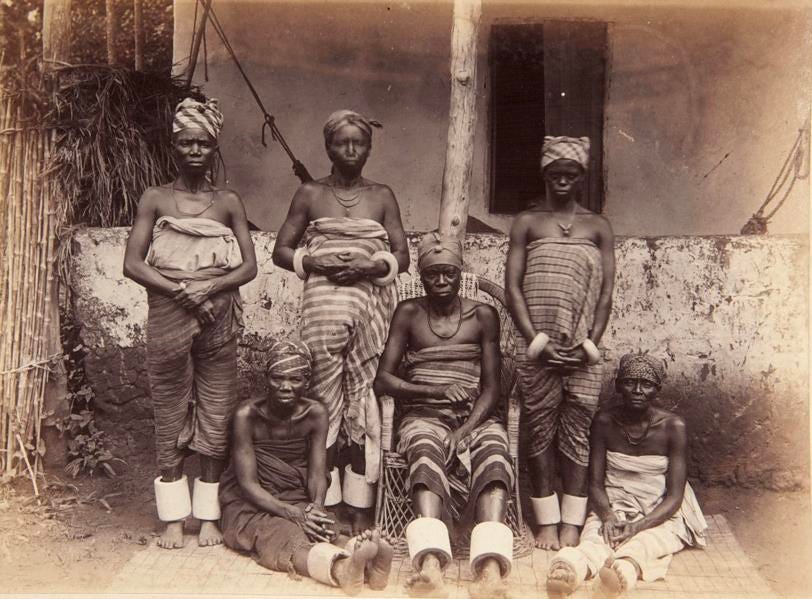
I was curious to read about the “anklets of brass” worn by the married women. These brass plates are called ogba and can be very large and cumbersome. Here are a couple of photos taken by the British anthropologist Northcote W. Thomas in the 1920s (photo one | photo two). They were a symbol of high status, given the value of the metalwork and the wearer’s inability to carry out domestic or agricultural labour. We might compare these to other impractical fashions promoted in other patriarchal societies.


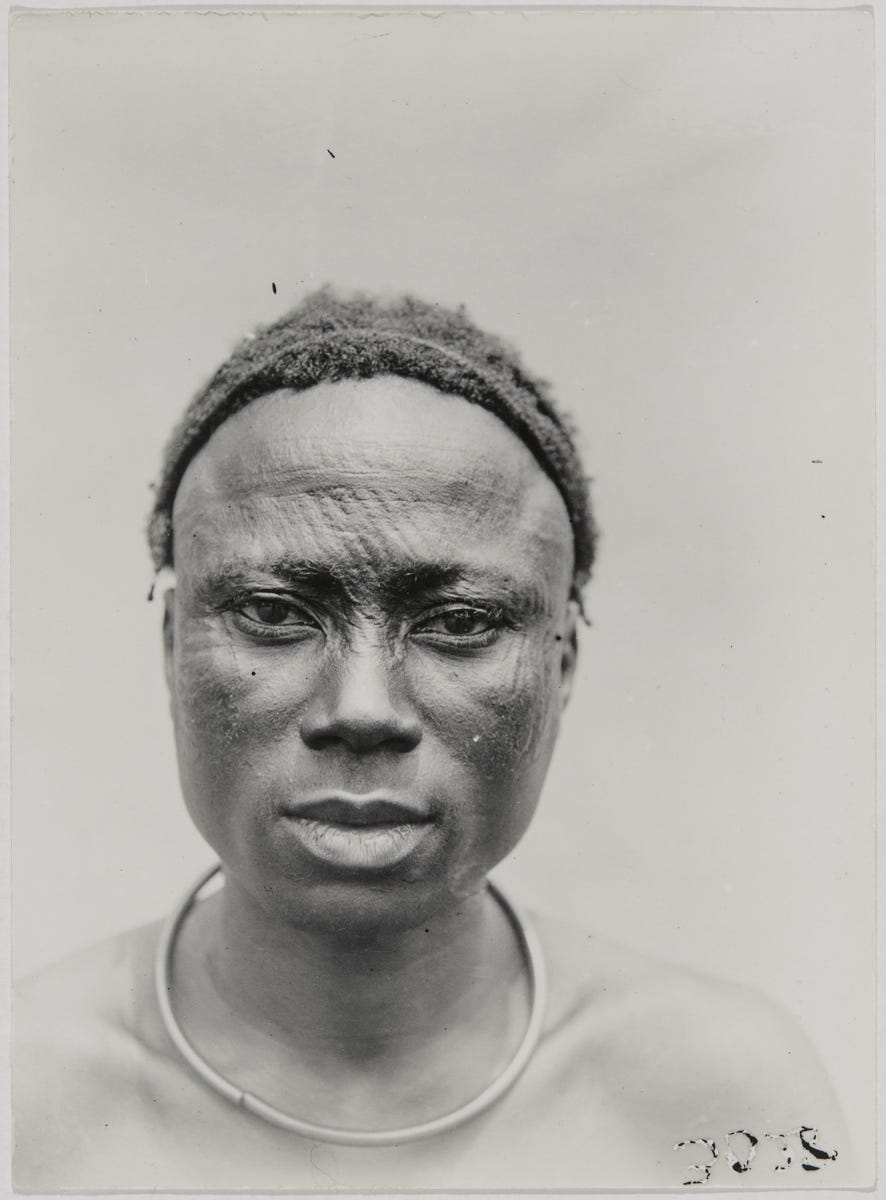
Many of the photos we have of Igbo life from this period were taken by Northcote W. Thomas. His Anthropological report on the Ibo-speaking peoples of Nigeria is available to read online. This short film by the [Re:]Entanglements project is a fascinating response to that colonial archive:
5. A good death
A man’s life from birth to death was a series of transition rites which brought him nearer and nearer to his ancestors.
What are the components of a good life and a good death in Igboland?
A wedding and a funeral bring our portrait of Igbo life to a conclusion. Part One began with a “bad death”: Okonwko’s father Unoka, carried to the Evil Forest to die alone and be left unburied. Okonkwo lives in fear of this death and must want to follow Ezeudu in joining the ancestors.
Footnote: Death and funerals in Igbo culture
Footnote: On Igbo burials. How Nigeria bid farewell to Chinua Achebe
6. Banishment
Ezeudu was the elder who warned Okonkwo of the decision to kill Ikemefuna. He told him, “Do not bear a hand in his death.” Ikemefuna called Okonkwo father, and Okonkwo ignored Ezeudu’s warning. Now, Okonkwo had killed Ezeudu’s son as well.
Why might Okonkwo’s exile seem ironic?
This is Okonkwo’s third action to anger the gods. In Chapter 4, he beat his wife during the Week of Peace, and atoned with an offering to Ani, the Earth goddess. In Chapter 7, he killed Ikemefuna. Obierika warned him that “it is the kind of action for which the goddess wipes out whole families.” Despite this, that action has gone unpunished.
The accidental killing of Ezeudu’s son requires a punishment of seven years’ exile. There’s that number seven again. And significantly, it is regarded as a lesser, “female” crime for being inadvertent. Okonkwo, who called his father womanly, and lived in fear of being seen as feminine, is banished for a “female” crime resulting from his mishandling of a firearm. When Okonkwo gets a gun, he either misses (in an act of domestic violence) or kills a bystander (at a funeral!). So much for Okonkwo, the great warrior.
As the elders said, if one finger brought oil it soiled the others.
So much of Part One has focused on the community’s concern for unity and maintaining traditions and links to their ancestors. There has been plenty of dissension and doubt that "the centre cannot hold”, and so we are left with Obierika trying to make sense of all those “greater complexities.”
In Part Two, the British will arrive. And things will really fall apart.
7. Glossary
ekwe A slit drum with rectangular slits in the surface and a hollow interior. The ekwe is used as a type of talking drum for communicating at long distances. Ekwe players use different rhythms for different purposes, from celebrations to emergencies.
Ekwenzu The Evil Spirit, a trickster spirit of confusion, and god of bargains and the tortoise. He is perceived as a spirit of violence that incites people to perform violent acts.
egwugwu Masked ancestral spirits that serve as judges and arbiters of justice.
iba A fever.
ilo The village square and meeting place.
obi The principal house in a compound occupied by the head of the household.
ogbu-agali-odu An evil spirit set loose on the world by a “medicine” that the people of Umuofia had forgotten how to control.
umunna A community with a common patrilineal lineage.
uri A woman’s betrothal ceremony.
Thank you
And thank you for reading and joining me on this slow read of Things Fall Apart by Chinua Achebe.
In the comments, let us know what caught your eye and ask the group any questions you may have. And if you’ve tumbled down a rabbit hole or taken your reading off on a tangent, please share where you have been and what you have found.
Next week, we will read chapters 14–19. The reading schedule, weekly posts and further resources can all be found on the main Things Fall Apart page of my website, Footnotes & Tangents.
This slow read and book guide is free. If you have enjoyed it and found it helpful, please consider a paid subscription or a one-off donation to support Footnotes & Tangents. Thank you!
Until next time, I wish everyone happy and adventurous reading.
Simon
Achebe has set the stage with all of the personalities, emotions, attitudes and events of life in a village. His perspective covers babies to grandparents. Life is revealed as somewhat messy, accidents happen, conflict and cooperation are present. I'm anxious about the falling apart. Diplomacy is not going to carry the day I fear.
I liked the Faces/Voices video. Photography was a completely different art in the early 1900s than it is now. The expressions on the faces of these people were genuine, come as you are. Natural wear and tear was evident. I took some time to try and imagine the world around them. The images reflected their world. The body art was varied. Skin was tattooed, scarified and elaborate hair designs were captured. When no false skin (clothing) is needed the decorating of real skin was art, communication, and a status symbol. Those visits from the photographer must have been a curious disruption to routine life. I have a few photos of my ancestors. At first glance I saw no emotion. Undoubtedly, they were sternly instructed to refrain from any movement because of the time needed to expose film.
The face at rest is rarely seen now. We say smile! Say cheese! Hundreds of digital photos are deleted in favor of the perfect look. Some folks are skilled at living with an artificial expression so any photos snapped are the best. But are they true? Do we respect true? If I'm sounding judgy ugh, I'll end with a little slice of life experience. Just after the pandemic settled, I was waiting in a hair stylist's chair. The young female stylist told me I had a good RBF. I didn't understand. She explained the Resting b**ch face. Her intention was not to criticize. This was just a thing girls were saying. My face at rest is not something I care to control. It reflects my world. [ironic chuckle]
Reading this section of the book, it felt like everything was falling apart, and that no one in the story could control anything. Okonkwo seems clearly headed for disaster, and I'm beginning to feel sorry for him.