

Endnotes #19: Tell me your slow read story
Monthly thread: What are you reading? • Exciting news • My recent reads

Hello everyone!
It’s Simon Haisell here, the host of Footnotes & Tangents, a website where I write guides to the books I love and invite you all to read with me at a gentle pace.
I’ve got some exciting news and a favour to ask below, but first
What have you been reading this month?
This is our monthly thread where we talk about the other books we’ve been reading. Let us know your recent and current reads below. The comments section gets fairly busy, so please put THE BOOK TITLE in capital letters to help fellow readers navigate the discussion. Thank you!
Our current slow reads
If you’re new here – hello! If you haven’t already done so, check out our big welcome post to find out what it is all about.
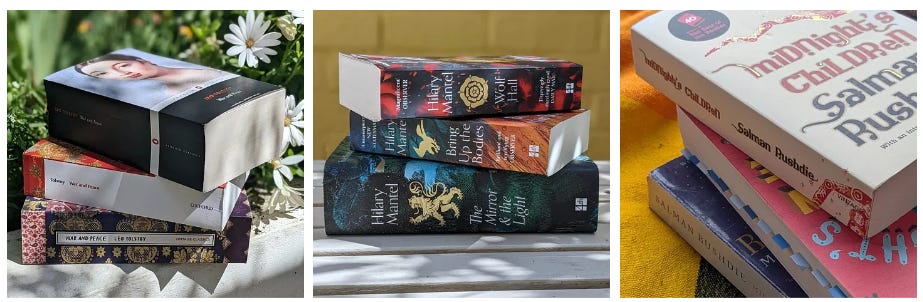
There are currently three read-alongs underway, with more planned later this year. It’s never too late to join in: everyone reads at their own pace, and everything I create is compiled into book guides – as of this month, there are over 150 posts on 9 books!
We’re in Week 8 of all our read-alongs:
War and Peace: Intro | Schedule | Week 1 | … | Week 8
Wolf Crawl: Intro | Schedule | Week 1 | … | Week 8
Midnight’s Children: Intro | Schedule | Week 1 | … | Week 8
Later this year: Regeneration by Pat Barker, The Inheritors by William Golding, Treacle Walker by Alan Garner, and The Children’s Book by AS Byatt.
Join a read-along by updating your notifications in your subscription settings.
Exciting news
So I have begun work on a book! I am excited, exhilarated and just a wee bit terrified by the prospect. And I am in the early days of planning, but I’ll keep you updated on its progress in the months ahead.
It will be a book about slow reading and a celebration of the sort of reading we do here at Footnotes & Tangents. The reading I am passionate about: intentional, curious and creative responses to books that are alive in the world.
And I need your help
At its heart, slow reading is about the reader’s journey.
Over the last three years, I have heard so many stories of how slow reading has impacted people’s lives: from building confidence and a reading habit to creating a calm refuge in a restless world, from nurturing curiosity and creativity to strengthening bonds between friends and family.
I want to get those stories into this book.
So I would love to hear from you. I have created an online form to record your stories, but you can also reply to this post or email me at footnotesandtangents@substack.com.
I am especially interested in
how your reading experience compares to how you read normally
how it has affected how you read other books
and any surprising ways it has impacted the rest of your life
Everything will be kept confidential, and I will always seek your permission before sharing your stories.
Thank you so much for all your time!
Going live
I’ve been too busy to do any Substack Lives this month. It’s our first year of having a child in school, and I’m still getting used to juggling work around school holidays!
But if all goes to plan this month, I’ll be popping up on Claire Venus ✨ and Jo Hutton’s podcasts, and on Tuesday 10 March I’ll be doing a live with Sabrina Nesbitt of The Middling Place to chat about our shared love of literature and slow reads. That’ll be at 8 PM GMT / 1 PM PDT, and we’ll share the video afterwards.
Watch again: Conversations with Sarah Fay | Sarah Steward Holland | Caroline Donahue
My recent reads
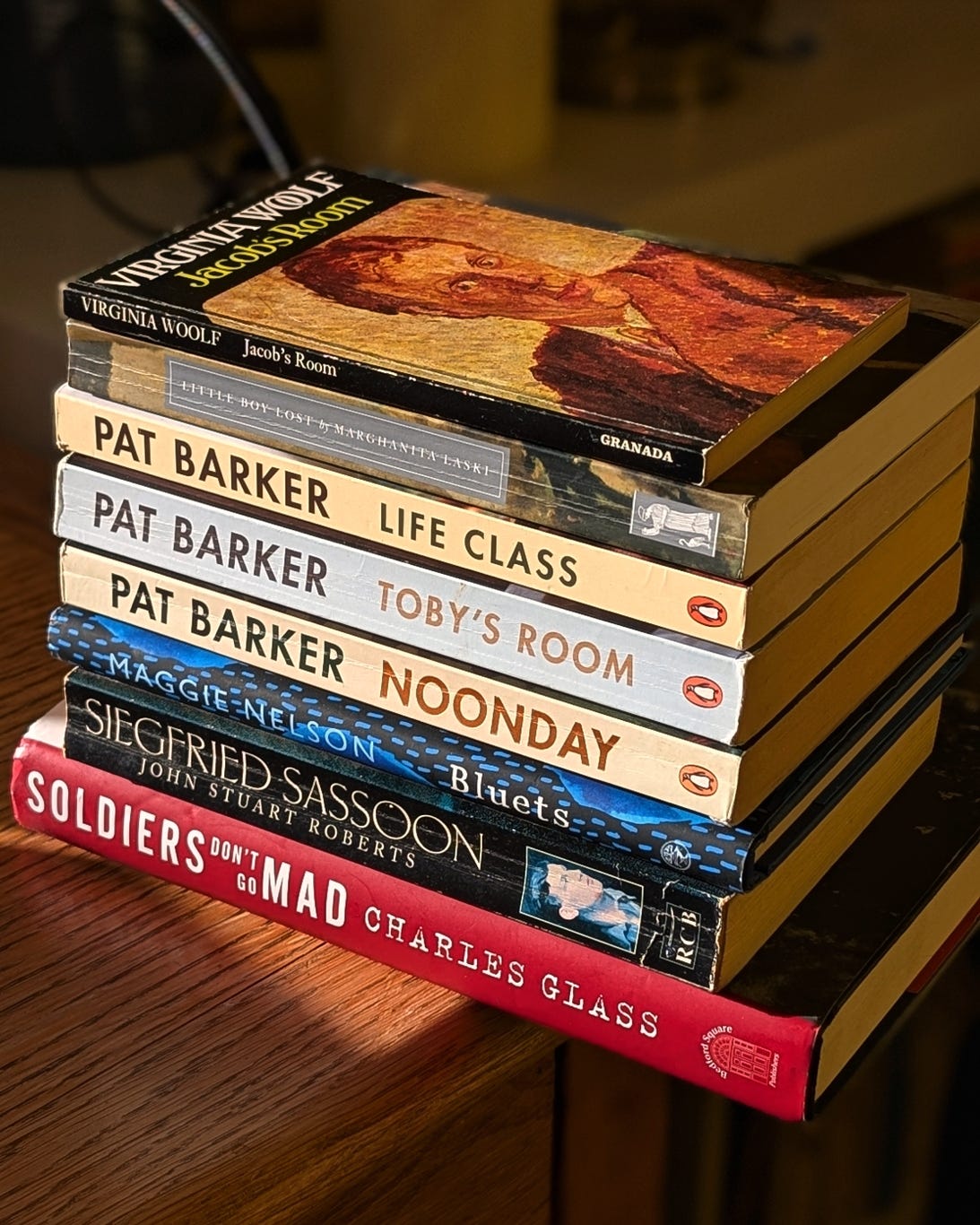
Here’s what I have been reading this month.
LITTLE BOY LOST (1949) by Marghanita Laski
This is a brilliantly haunting book. In the aftermath of the Second World War, a British poet goes to France in search of his lost son. His inner world resembles the bombed-out world he moves through, and the "little boy lost" is both himself and the boy who may or may not be his. A book full of ruins.
BLUETS (2009) by Maggie Nelson
What's your favourite colour? According to Nelson, half of the adults in the Western world say theirs is blue. Myself included. Nelson’s response to the colour is entirely her own – tinged with heartbreak, inked with sex – and it makes for a curious addendum to our slow read of Penelope Fitzgerald's The Blue Flower.
LIFE CLASS (2007) by Pat Barker
With our slow read of Barker’s Regeneration coming in April, I decided to read some more of her novels. The Life Class trilogy explores how artists depicted the destruction wrought by the First World War. The main characters are young students at the Slade School of Art, who meet in Henry Tonks's life-drawing class. And they are still sketching out their lives when the war tears through everything, altering how they see each other and the world. It’s a book about looking that gets deeper and darker the further in you go.
TOBY’S ROOM (2012) by Pat Barker
For me, this second book is the strongest in the trilogy. The novel's title is a nod to Virginia Woolf, whose brother, Thoby, died at 26 of typhoid. Woolf’s novel Jacob's Room tells the life of a young man through the thoughts of those around him. Barker does something similar for Toby Brooke, who is reported as "Missing, believed killed" in 1917. We piece together the truth through the narratives of his sister Elinor, and her fellow war artists Kit Neville and Paul Tarrant.
NOONDAY (2015) by Pat Barker
In the final book of the trilogy, the narrative jumps to the 1940s and the Blitz, and to a denouement in the ruins between the three main characters, overburdened with grief, bitterness, and loss. The leap forward in time is jarring, and the characters feel peculiarly underdeveloped and out of place against the finely researched backdrop of the Blitz.
JACOB’S ROOM (1922) by Virginia Woolf
After Toby’s Room, I had to read Jacob’s Room! Perhaps because I listened to Juliet Stevenson read this, I thought about how it would make a great radio play. A play for voices, like Under Milk Wood by Dylan Thomas: its audience eavesdropping on the mind streams of so many people, but with one melancholy exception. An eerie absence at its heart, waves of other people's thoughts pushing you back to land as his are lost forever out to sea.
SIEGFRIED SASSOON (1999) by John Stuart Roberts
This was background reading for our slow read of Pat Barker's Regeneration. In Barker's novel, Sassoon and Wilfred Owen are patients at Craiglockhart War Hospital. At the heart of the book is Sassoon’s mentorship of Owen and his fascinating exchanges with the psychiatrist and anthropologist W H R Rivers. However, reading this biography gave me the impression that the real Sassoon was the least compelling of these three men. As a sensitive young man in love with words, he struggled to find the object for his poetry that war so acutely supplied. Though he lived another fifty years, he never seemed to recapture that urgent ferocity of voice during the war.
SOLDIERS DON’T GO MAD (2023) by Charles Glass
Continuing my background reading for Regeneration. This is an excellent companion book to Barker's novel, with detailed chapters on the Craiglockhart War Hospital, its patients Max Plowman, Wilfred Owen and Siegfried Sassoon, and its chief psychiatrists Arthur Brock and WHR Rivers. If you are joining us in April and would like an introduction to the book, I think this would be a fine place to start.
What have you been reading?
Now it’s over to you. Let us know what you’re reading in the comments.
And if you can put THE BOOK TITLE in capital letters, it will help others find books they love or may be interested in.
All the best and happy, adventurous reading,
Simon
SMALL THINGS LIKE THESE by Claire Keegan, a small sized book that addresses a huge moral dilemma. How does a solid member of a small Irish town address the horror the Catholic Church is inflicting on a young girl who is 14 weeks postpartum? Very topical for our time in the US and beautifully written. Made into a movie that is also very good.
I am reading WUTHERING HEIGHTS for the first time and I love it.